Spinal function
How does the movement relate to the position and function of the spine?
Yoga Payammehr · Educators
From growing up among yoga teachers to asking how postures relate to one another, Maya’s story is about practice as a thoughtful, connected experience.
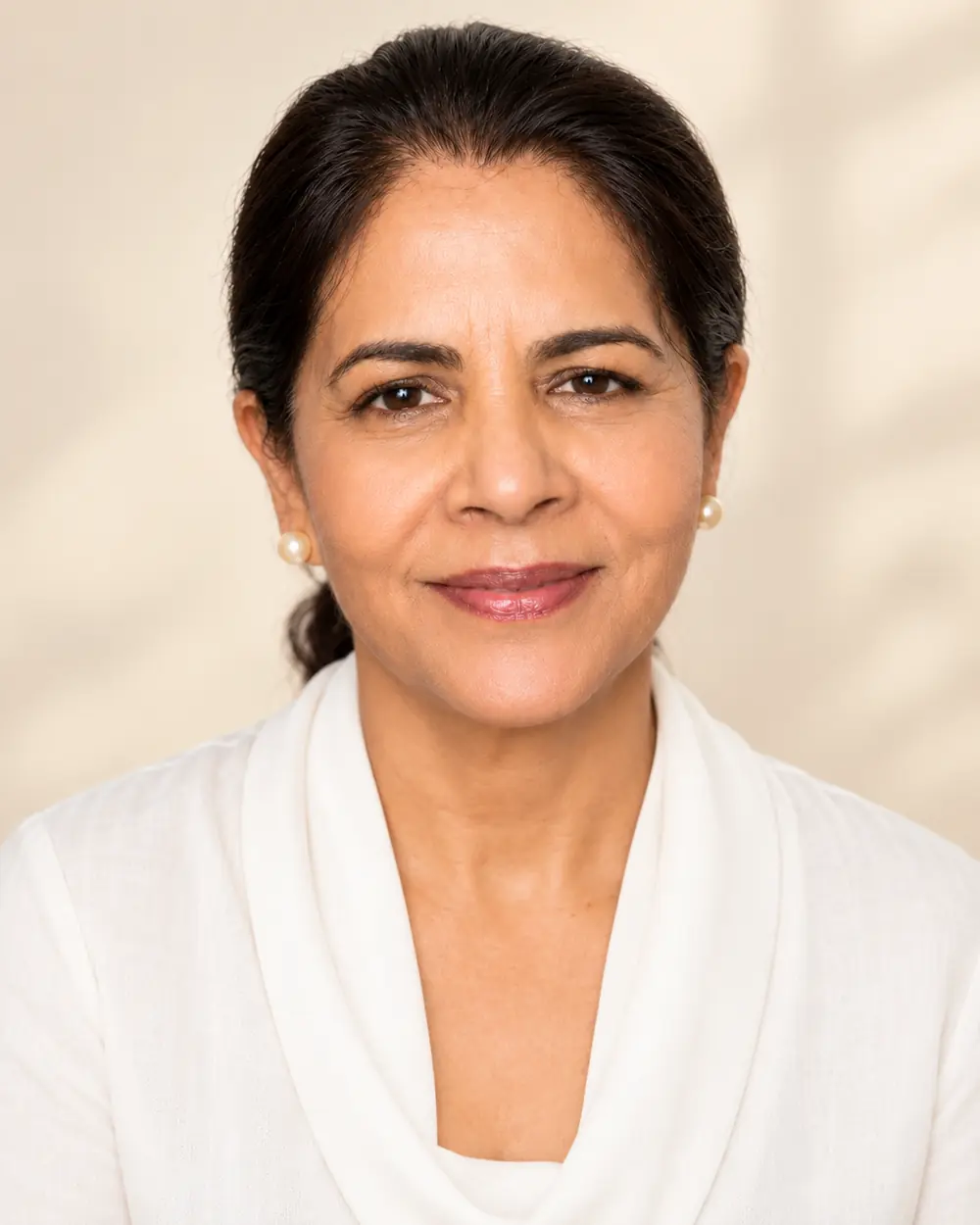
In Maya’s voice · Edited account
My interest in yoga began when I was a child. My mother taught yoga, and our home was a place where teachers and practitioners came together to exchange ideas. I did not understand all of their discussions about philosophy and practice, but I loved listening.
When I later began teaching, a question stayed with me: why do students experience the same practice so differently? Why might a posture become uncomfortable when attempted without sufficient preparation or adaptation?
Those questions led me to further study, conversations with experienced teachers and physicians familiar with yoga, and a closer look at how asanas are arranged. I came to see that the selection of a posture was not the whole story; preparation, sequence, transitions, and recovery mattered too.
Where the teaching journey began
Maya Machawe was born in Pune, India, and grew up in Ahmedabad, Gujarat. Her earliest yoga education came from her mother, who taught yoga; before moving to Iran, Maya also learned from a number of other teachers.
That early immersion developed into a lifelong commitment to learning and teaching, later including her collaboration with Dr Saed Ahmadi. These biographical details are drawn from a historical account supplied by Yoga Payammehr.
How the method took shape
In her personal account, Maya describes working with Dr Saed Ahmadi to study the role of asana sequencing. She reports examining 77 postures over roughly three years and organizing them by their physical and practical characteristics.
She describes arranging principal movements alongside preparatory ones, with each sequence designed to help students approach the next movement with appropriate preparation. A related set of movements was called a “cycle.”
This is an educational and historical account of the method’s development, not independent confirmation of a clinical study. The original manuscript’s claims about clinical observations should not be presented as proven treatments without accessible research records.
Principles of sequencing
Maya’s manuscript describes six criteria used to study and connect postures. They characterize the teaching approach; they are not medical prescriptions or a universal sequence for every body.
How does the movement relate to the position and function of the spine?
What range of joint motion and patterns of contraction and stretch are involved?
What are the experiential physical and attentional characteristics of the posture?
What flexibility and preparation does the posture require?
How can the student move into and out of the posture with attention and control?
Which preparatory movements may be helpful before the principal posture?
Milestones from the school’s historical account
The dates below are recorded in the biographical material supplied by Yoga Payammehr. Archival copies of publications, certificates and honours can be presented separately when available for review.
The account dates the gradual use and development of early Cyclic Yoga notes and teaching cycles to this Solar Hijri year (1984–85).
Maya reportedly helped develop teacher-training materials and served for more than five years among experts and examiners for women’s yoga instructor programmes.
The school’s historical account names Maya Machawe and Dr Saed Ahmadi as co-founders and records 19 Shahrivar 1376 as its establishment date in Tehran.
The account records a 180-page Cyclic Yoga book issued by Peyk-e Farhang in Farvardin 1377 (spring 1998).
Maya helped develop and write for a colour yoga magazine launched in summer 1379 SH, with Dr Saed Ahmadi serving as editor-in-chief.
Writing and educating the next generation
According to the school’s biographical record, Maya prepared teaching materials spanning yoga foundations, teacher education, anatomy and physiology, Yama and Niyama, Yoga Nidra, pranayama, attention and meditation. This is a record of past educational work, not a list of courses currently open.
She also wrote for the Payammehr periodical on yoga practice, breathing and the ethics of peaceful living. The school’s account describes former students who went on to become yoga teachers themselves — a legacy of education carried into the next generation.
Some additional book titles appear in the source without confirmed publication dates or as works then in preparation. They are not represented here as published books until bibliographic evidence is available.
Teaching today
At Yoga Payammehr, movement, breathing, observation, and reflection are understood together. This profile introduces Maya’s personal journey; the dedicated Cyclic Yoga page explains the teaching approach in more detail.
Current courses and registration details are presented separately. This educator profile does not promise therapeutic outcomes or announce a particular course as open for enrollment.
Stay in conversation
Learn more about the school’s distinctive method and the idea of connecting postures into a cycle.